Category: Sport Psychology · Psychological Flexibility · Performance Anxiety
By Dr. Trent Claypool, PsyD · Sport Psychologist, Colorado Springs · February 2026 12-minute read
As a sport psychologist, I have watched the same scene play out hundreds of times. An athlete is standing behind the blocks, sitting in the bullpen, or crouching at the start line. The moment arrives. And their heart rate spikes, their stomach knots, and a familiar internal voice says: “Not now. Don’t be nervous. Get it together.”
What happens next determines whether they perform or fall apart—and it has almost nothing to do with talent, preparation, or willpower.
The original discomfort—the butterflies, the adrenaline, the heightened arousal—gets joined by a second, entirely self-generated layer of suffering: frustration at feeling nervous, anxiety about the anxiety, shame for not being mentally tougher. That second layer is what sabotages performance. And the traditional sport psychology world has, for decades, been inadvertently teaching athletes to create more of it.
In Acceptance and Commitment Therapy (ACT), we call this the distinction between clean discomfort and dirty discomfort—and in my work providing ACT-based therapy for athletes, understanding it is often the single most transformative shift for performance anxiety in athletes.
What Is Clean Discomfort? Understanding Normal Athletic Arousal
Clean discomfort is the primary pain or discomfort that shows up naturally in response to life circumstances (Hayes, Strosahl, & Wilson, 2012). In athletics, this includes pre-competition nerves, the burn of a hard interval, frustration after a mistake, disappointment after a loss, and the vulnerability of competing in front of others. It arrives uninvited, it is neurobiologically wired, and it is not the problem.
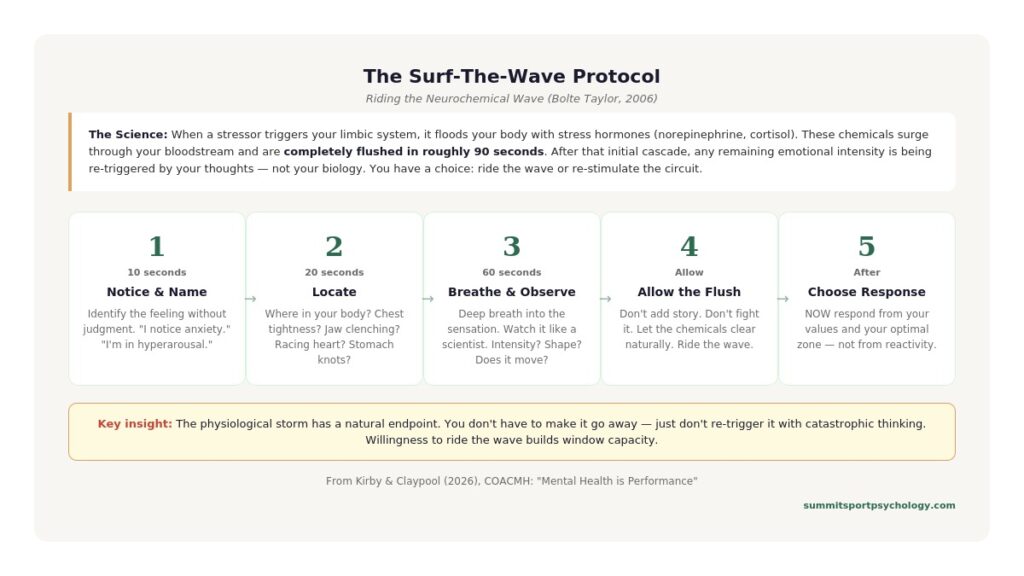
Neuroscientist Jill Bolte Taylor (2006) explains the science behind this: when a stressor triggers your limbic system, stress hormones like norepinephrine and cortisol surge through your bloodstream and are completely flushed within about 90 seconds. The physiological event is brief. It has a natural endpoint. After that initial neurochemical cascade, any remaining emotional intensity is being driven by your thoughts and interpretations—not your biology.
This is a fact that changes everything for athletes struggling with competition anxiety: the feeling you are so desperate to eliminate has an expiration date of roughly a minute and a half. If you let it.
Key Distinction
Clean Discomfort is not the enemy. It is information.
Pre-race butterflies tell you the event matters. The burn at mile 20 tells you that you are expanding your capacity. Frustration after a dropped pass tells you that you care about excellence. These are features of a healthy nervous system doing its job—not symptoms of a broken mind that needs fixing. The question is never “How do I stop feeling this?” It is “How do I relate to this feeling so it does not consume me?”
What Is Dirty Discomfort? The Hidden Performance Killer
Dirty discomfort is the secondary suffering we create through our relationship with the original discomfort (Harris, 2009). It is what happens when we fuse with our thoughts, fight our feelings, or layer judgment on top of a normal human experience.
Dirty discomfort sounds like:
- “I shouldn’t be this nervous. Something is wrong with me.”
- “Real competitors don’t feel this way. I’m weak.”
- “If I can’t control my anxiety, I’ll choke again just like last time.”
- “I need to get rid of this feeling before I can perform.”
Notice the pattern: each of these takes the original, time-limited, clean discomfort and adds a story, a judgment, or a control agenda on top of it. The athlete is no longer experiencing nerves—they are experiencing nerves plus self-criticism plus panic about the nerves plus desperate attempts to suppress all of it. Russ Harris (2009) calls this having the “struggle switch” flipped ON—and research on thought suppression (Wegner, 1994) consistently demonstrates that the harder you try not to think or feel something, the more intensely you experience it.
Clinical Vignette
I worked with a Division I cross-country runner who came in describing crippling pre-race anxiety. When we mapped out what was actually happening, the clean discomfort—elevated heart rate, stomach tension, restlessness—was lasting about two minutes before the gun. Manageable. What was lasting for hours was the dirty discomfort: the obsessive analysis of whether she felt ready, the self-criticism for feeling nervous when her teammates looked calm, and the catastrophic prediction that feeling this way meant she would have a bad race. By the time she toed the line, she had been fighting herself for hours. She had nothing left for the race.
We did not fix her nerves. We taught her to stop fighting them. Her season-best PR came six weeks later—and she described feeling more anxious before that race than any other. The difference was she surfed the wave instead of drowning in the struggle.
Composite case example drawn from clinical practice
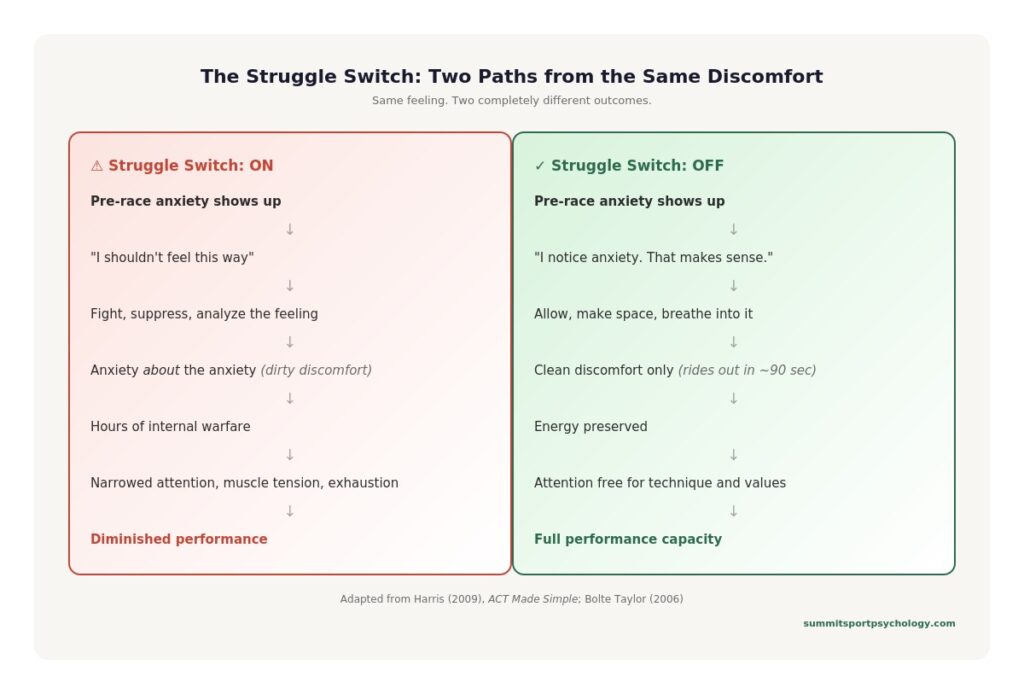
The Hidden Energy Cost: How Fighting Feelings Drains Performance
Here is what makes this distinction so critical for athletes seeking mental performance coaching: dirty discomfort is extraordinarily expensive. When an athlete is locked in an internal battle against their own feelings, cognitive and physiological resources that should be available for performance get rerouted to the struggle (Gross, 2015).
Wegner’s (1994) research on ironic process theory demonstrates this clearly: the act of trying not to think about something requires a monitoring process that, paradoxically, keeps the unwanted thought active. Telling yourself “don’t be nervous” is programming your brain to scan for nervousness—which amplifies the very state you are trying to eliminate. The athlete pays twice: once for the original discomfort, and again for the energy consumed by fighting it.
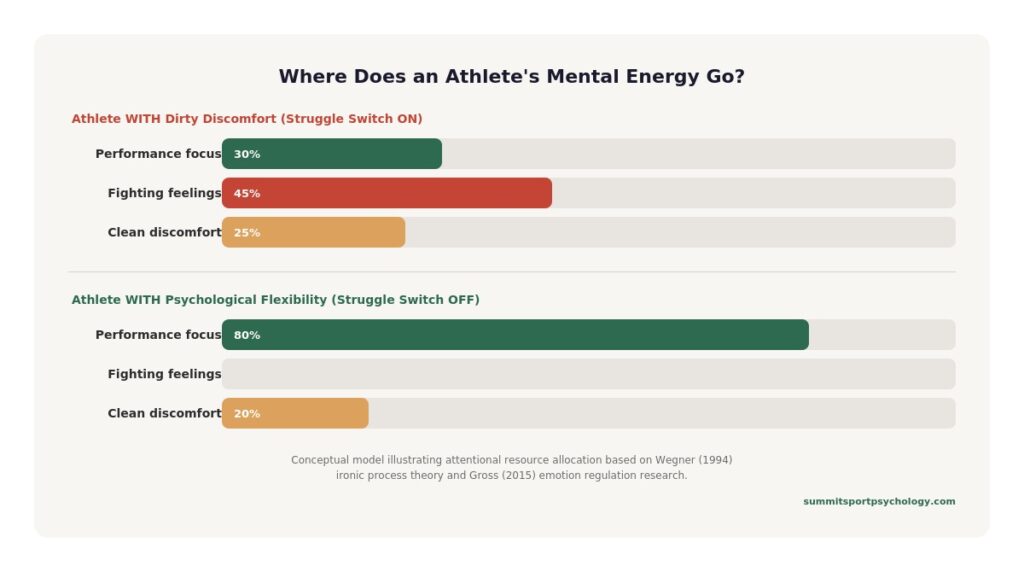
The numbers shift not because you eliminate the clean discomfort—you do not—but because you stop adding to it. All of that energy that was going toward the internal battle comes back online for performance. This is the practical payoff of psychological flexibility.
[convertkit form=9107531]
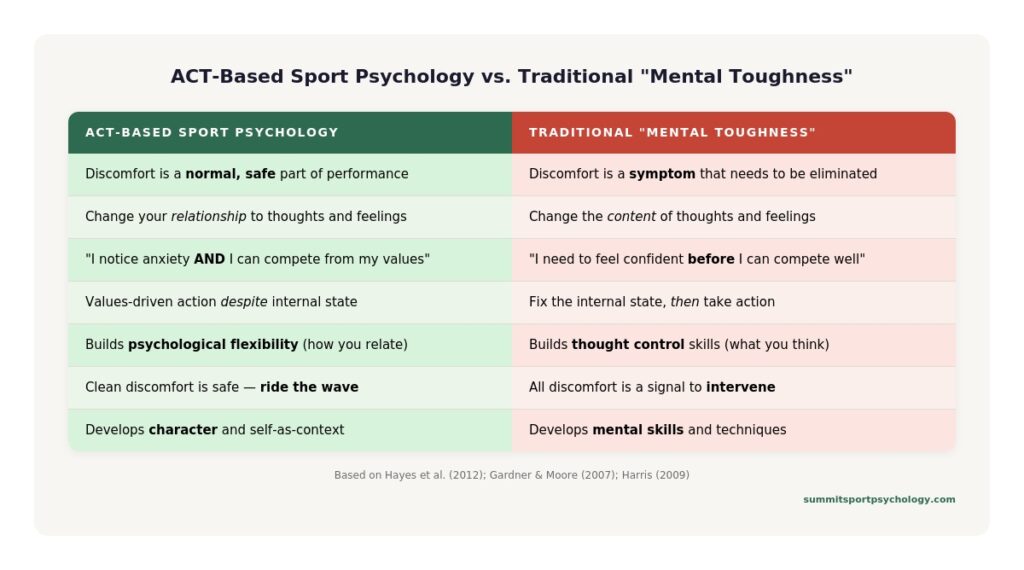
ACT-Based Sport Psychology vs. Traditional Approaches to Performance Anxiety In Athletes
This is where the conversation gets interesting—and where I believe the field of sport psychology needs a fundamental course correction.
Traditional psychotherapy—particularly classic CBT—often operates on an implicit assumption that certain internal experiences are problems to be solved. Anxiety? Restructure the cognitions causing it. Negative self-talk? Replace it with positive self-talk. The underlying message, however well-intentioned, is: these feelings are bad and need to be changed before you can function.
For an athlete dealing with performance anxiety, this framework creates a particular trap. It teaches the athlete that they need to fix their inner world before they can perform in the outer one. They develop a conditional relationship with performance: “I can compete well only if I feel confident, calm, and in control.” This is, functionally, a recipe for more dirty discomfort—because now every wobble in confidence becomes evidence that performance will suffer.
ACT-based sport psychology (Hayes et al., 2012; Gardner & Moore, 2007) takes a fundamentally different stance: the goal is not to change what you feel but to change your relationship with what you feel. The butterflies can stay. The doubt can be present. The fatigue can show up. And you can still perform valued action alongside all of it. This is psychological flexibility—and meta-analytic research consistently identifies it as one of the strongest predictors of both mental health and performance outcomes across populations (Kashdan & Rottenberg, 2010; Ruiz, 2010).
The Neurobiological Case: Why Clean Discomfort Is Safe (Window of Tolerance)
One of the most powerful things we can teach athletes is that clean discomfort is neurobiologically safe. In a recent presentation I developed with Dr. Jess Kirby at the COACMH 2026 conference—titled “Mental Health is Performance”—we walked coaches through the neuroscience behind this claim using Dan Siegel’s (2020) Window of Tolerance model and its direct connection to athletic performance.
When an athlete operates within their Window of Tolerance—the optimal arousal zone where the autonomic nervous system maintains balanced sympathetic-parasympathetic interplay—they can experience significant activation and still maintain the capacity to think clearly, respond flexibly, and execute their skills (Siegel, 2020). Race-day adrenaline within the window is not a problem. It is fuel. The nervous system is designed for this.
The critical question is: what narrows the window and pushes athletes outside it? And here is where the clean/dirty discomfort distinction becomes neurobiologically urgent.
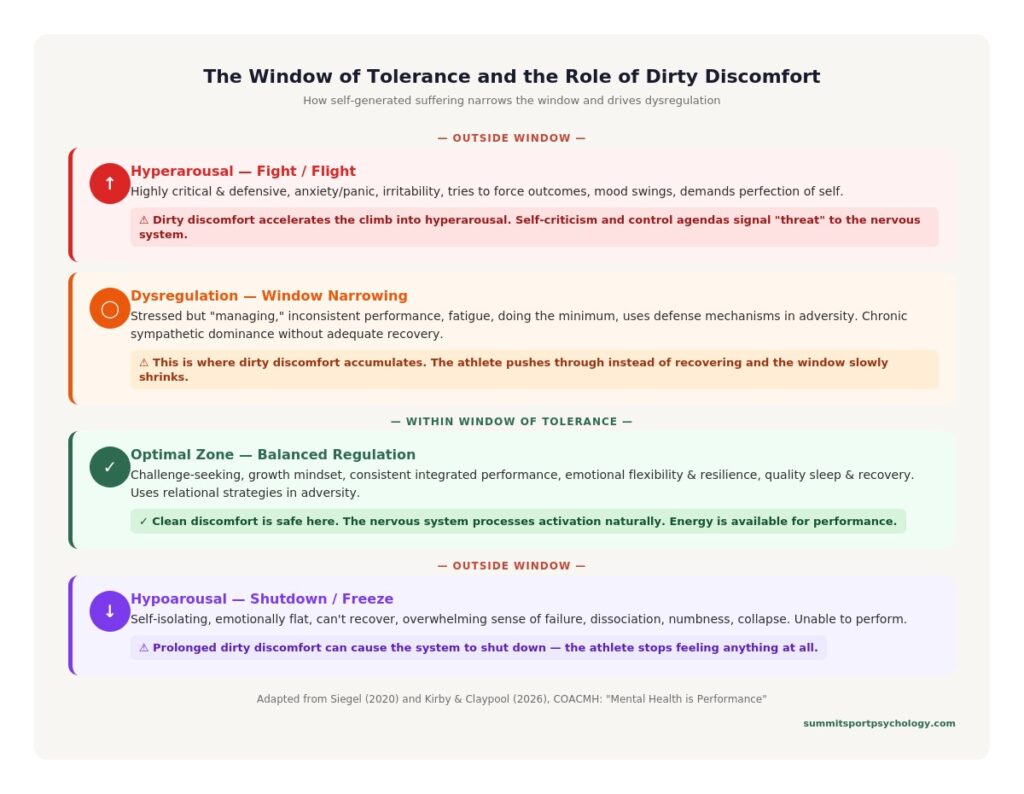
When you layer judgment, self-criticism, and a control agenda on top of clean discomfort, you tell your nervous system: “This internal experience is a threat.” The nervous system listens. It ramps up the threat response. The window narrows. The athlete loses access to their cognitive and motor skills—not because the original feeling was dangerous, but because the fight against it created a cascading neurobiological emergency.
This is also why the mental health continuum and the performance continuum are not separate tracks—they are the same track. As Dr. Kirby and I showed in our COACMH presentation, athletes move along a continuum from thriving to crisis, and their performance tracks that movement in lockstep. Mental health is performance.
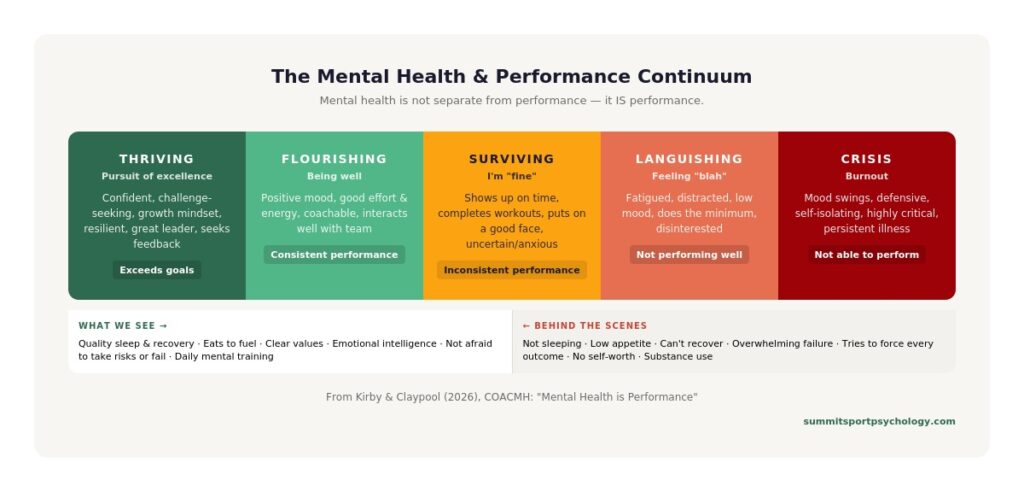
The physiological storm has a natural endpoint. You don’t have to make it go away—just don’t re-trigger it with catastrophic thinking. Willingness to ride the wave for 90 seconds builds window capacity.”— Kirby & Claypool (2026), The Surf-The-Wave Protocol
Self-as-Context: The Character Development That Transforms Performance
So how do athletes actually develop the capacity to experience intense clean discomfort and treat it as safe rather than threatening? The answer lies in one of ACT’s most powerful—and most underutilized—processes: self-as-context (Hayes et al., 2012).
In ACT, we distinguish between three senses of self. Self-as-content (“the conceptualized self”) is the story we tell about who we are: “I am an anxious person,” “I am not clutch,” “I am a choker.” Self-as-process is ongoing awareness of what we are experiencing right now: “I notice my heart racing.” And self-as-context is the observing perspective itself—the stable, continuous “you” that has been present across every experience you have ever had.
Self-as-context is the part of you that can say, “I notice I am having the thought that I am going to fail,” rather than being fused with, “I am going to fail.” It is the difference between being caught in a storm and watching the storm from a sheltered vantage point. The storm is just as intense—but your relationship to it has fundamentally changed.
This matters enormously for athletes because self-as-context creates the observing position from which clean discomfort becomes safe. When you can observe your anxiety rather than be your anxiety, the threat dissolves. The sensation is still present, but you are no longer trapped inside it. You have created a psychological space—what Harris (2009) calls “expansion”—where difficult internal experiences can exist alongside effective action.
Why Self-as-Context Is Character Development, Not a Performance Hack
This is not a technique you deploy in the moment. It is a fundamental shift in how you relate to your entire inner world.
Traditional sport psychology often teaches mental “skills”—isolated techniques (visualization, positive self-talk, breathing drills) pulled out when things get hard. Self-as-context is different in kind. It develops across sessions, through practice, through the willingness to sit with discomfort again and again without fusing with it. It changes not just how you handle competition pressure but how you handle criticism from a coach, conflict with a teammate, failure in training, and the existential weight of tying your identity to outcomes. It is the foundation of durable resilience—and it is what I mean when I describe the work at Summit Sport Psychology as character development rather than mental skills training.
This is also why I integrate biofeedback and neurofeedback alongside ACT in my practice. Self-as-context is a perspective-taking skill, and it can be powerfully accelerated when athletes can see their nervous system in real time. When a runner watches her heart rate variability shift as she practices expansion with a pre-race anxiety cue, the abstract concept of “making space for discomfort” becomes a concrete, visible, neurobiological reality. The body teaches the mind what the mind struggles to believe on its own: this feeling is safe. You can hold it. It will pass.
Two Evidence-Informed Protocols for Athletes and Coaches
In the COACMH 2026 presentation, Dr. Kirby and I shared two protocols that teach athletes to practice this shift in real time. Both are grounded in the principle that you do not need to fix your internal state to perform—you need to learn to ride it.
Protocol 1: Surf the Wave (Bolte Taylor, 2006)
Based on the neurochemical reality that stress hormone cascades flush through the body in a relatively short amount of time in most circumstances (i.e. a few minutes). After the initial wave, remaining emotional intensity is maintained by your thoughts and interpretations—not your biology.
Protocol 2: The Expansion Technique (Harris, 2009)
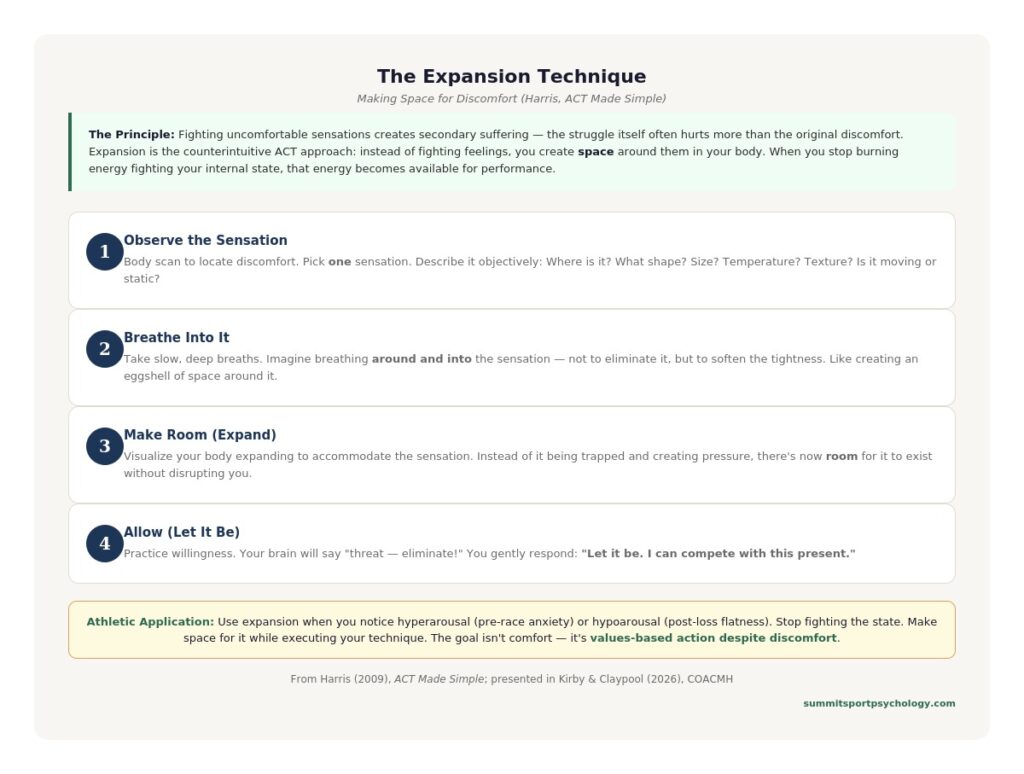
This ACT-based technique addresses the core problem directly: when you stop burning energy fighting your internal state, that energy becomes available for performance. Expansion teaches athletes to create space around discomfort rather than contracting against it.
The four steps: Observe the sensation with scientific curiosity (where is it, what shape, what temperature?), Breathe around and into it like creating an eggshell of space, Make Room by visualizing your body expanding to accommodate the sensation, and Allow it to be present while you execute your technique and compete from your values.
The goal is not comfort. The goal is values-based action despite discomfort. That is psychological flexibility in a sentence.
What This Means for Athletes, Coaches, and Parents
The traditional “mental toughness” paradigm told athletes they needed to dominate their inner world the same way they dominated their competition. Push through. Stuff it down. Control the narrative. Be strong.
The evidence tells a different story. Perfectionism, emotional avoidance, and rigid coping strategies are consistently associated with burnout, performance decrements, and mental health difficulties in athletes (Hill, Mallinson-Howard, & Jowett, 2018; Lundqvist, 2011). The athletes who perform most consistently under pressure are not the ones who feel nothing—they are the ones who can feel everything and still act from their values (Gardner & Moore, 2007; Kashdan & Rottenberg, 2010).
Clean discomfort is not the enemy. It is the raw material of growth. This is what actually resolves performance anxiety in athletes — not by eliminating feelings, but by changing the relationship to them. When an athlete learns to hold their discomfort with willingness rather than war, they develop something far more durable than toughness: they develop flexibility, resilience, and a relationship with themselves that can withstand anything competition throws at them.
That is not a mental skill. That is character development. And it is what transforms performance from the inside out.
Ready to Move Beyond Mental Toughness?
Whether you are an athlete struggling with performance anxiety, a coach who wants to understand the mental health–performance connection, or a parent trying to support your young athlete—let’s talk about what evidence-based sport psychology actually looks like.
👉 Schedule a Free Consultation Or explore services at summitsportpsychology.com
Frequently Asked Questions About Clean and Dirty Discomfort
What is clean discomfort in sport psychology? Clean discomfort is the primary, natural pain or activation that shows up in response to athletic challenges—pre-competition nerves, the burn of hard effort, frustration after a mistake. It is neurobiologically normal, time-limited (stress hormones flush in roughly 90 seconds), and is not the actual problem in performance anxiety. It is a feature of a healthy nervous system, not a symptom of a broken mind.
What is dirty discomfort and how does it hurt performance? Dirty discomfort is the secondary suffering athletes create by fighting, judging, or trying to suppress their original feelings. It sounds like “I shouldn’t feel this nervous” or “I need to fix this before I can compete.” Research on thought suppression (Wegner, 1994) shows this internal struggle consumes cognitive resources that should be available for performance, narrows the athlete’s Window of Tolerance, and can trigger further nervous system dysregulation.
How is ACT-based sport psychology different from traditional mental toughness training? Traditional mental toughness training often teaches athletes to control, suppress, or replace uncomfortable feelings—essentially creating more dirty discomfort. ACT-based sport psychology takes the opposite approach: instead of changing what you feel, you change your relationship with what you feel. The goal is psychological flexibility—the ability to take values-driven action even when difficult thoughts and feelings are present (Hayes et al., 2012).
What is self-as-context and why does it matter for athletes? Self-as-context is the observing self—the part of you that can notice thoughts and feelings without being consumed by them. For athletes, it creates the psychological space where clean discomfort becomes safe: you can observe your anxiety rather than be your anxiety. This is the foundation of durable resilience and consistent performance under pressure, and it is why this work is fundamentally about character development rather than mental skill acquisition.
Keep Reading
- The Negativity Instinct: How Negative Self-Talk Undermines Athletes and Team Culture
- Understanding Competition Anxiety: A Sport Psychologist’s Guide
- ACT Therapy for Athletes: How It Works
- Perfectionism Counseling for Athletes
About the Author
Dr. Trent Claypool, PsyD Licensed sport psychologist and founder of Summit Sport Psychology in Colorado Springs, CO. Specializing in ACT-based approaches, EMDR, biofeedback, and neurofeedback for athletes from youth through professional levels. A former senior national-level swimmer turned endurance athlete who believes the path to performance runs through psychological flexibility, not mental toughness. Schedule a free consultation →
References
Bolte Taylor, J. (2006). My stroke of insight: A brain scientist’s personal journey. Viking.
Gardner, F. L., & Moore, Z. E. (2007). The psychology of enhancing human performance: The Mindfulness-Acceptance-Commitment (MAC) approach. Springer Publishing.
Gross, J. J. (2015). Emotion regulation: Current status and future prospects. Psychological Inquiry, 26(1), 1–26.
Harris, R. (2009). ACT made simple: An easy-to-read primer on Acceptance and Commitment Therapy. New Harbinger Publications.
Hayes, S. C., Strosahl, K. D., & Wilson, K. G. (2012). Acceptance and Commitment Therapy: The process and practice of mindful change (2nd ed.). Guilford Press.
Hill, A. P., Mallinson-Howard, S. H., & Jowett, G. E. (2018). Multidimensional perfectionism in sport: A meta-analytical review. Sport, Exercise, and Performance Psychology, 7(3), 235–270.
Kashdan, T. B., & Rottenberg, J. (2010). Psychological flexibility as a fundamental aspect of health. Clinical Psychology Review, 30(7), 865–878.
Lundqvist, C. (2011). Well-being in competitive sports—The feel-good factor? International Review of Sport and Exercise Psychology, 4(2), 109–127.
Ruiz, F. J. (2010). A review of Acceptance and Commitment Therapy (ACT) empirical evidence. International Journal of Psychology and Psychological Therapy, 10(1), 125–162.
Siegel, D. J. (2020). The developing mind (3rd ed.). Guilford Press.
Wegner, D. M. (1994). Ironic processes of mental control. Psychological Review, 101(1), 34–52.