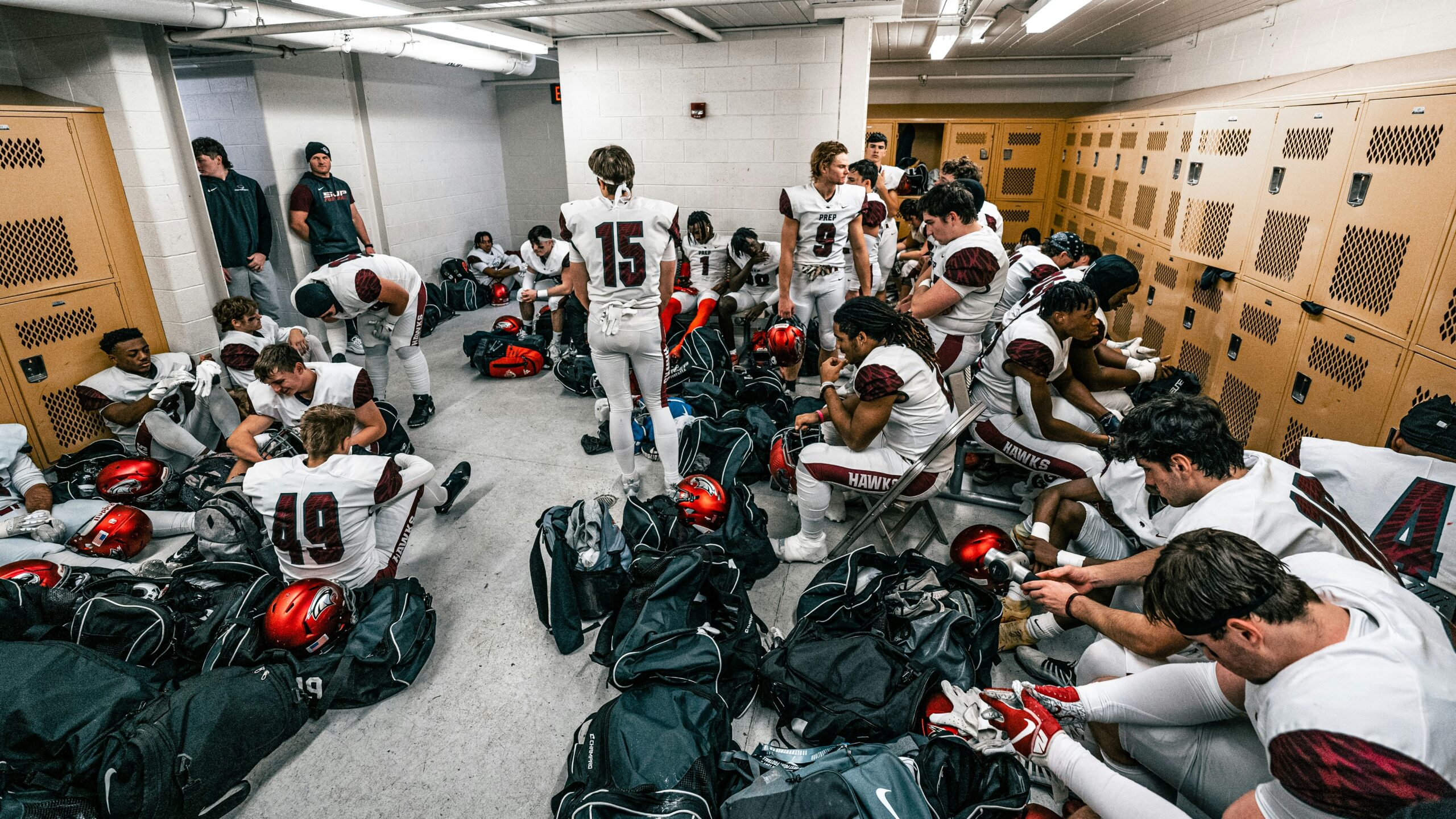
There’s a moment most coaches and team leaders know, even if they’ve never named it.
Something happens in the room — a comment that lands wrong, a teammate cutting someone down, a culture norm that quietly contradicts everything your program says it stands for — and the room goes still. Not because nobody noticed. Not because nobody cared. But because something powerful and invisible held everyone in place.
We call it a bystander moment. And in my work as a sport psychologist, I’d argue it’s one of the most consequential dynamics operating inside every team you’ll ever lead. Not just in the context of hazing or sexual violence prevention — though both matter enormously — but in the everyday, unremarkable moments where culture is actually built or quietly eroded: how a mistake gets handled in film review, whether a captain challenges a teammate who’s cutting corners, how feedback travels across a locker room. These are the moments that determine whether your team learns or stays stuck.
If you want a team that acts in those moments — one that corrects mistakes, gives honest feedback, and holds each other accountable — you first need to understand why good people so often don’t.
The Bystander Effect in Teams: Why Speaking Up Feels Dangerous
Before we can talk about building a culture of accountability, we need to get honest about why silence is the path of least resistance for most athletes. This isn’t a character flaw. It’s a predictable response to a social environment that quietly rewards staying quiet — and the research makes this clear.
Barrier 1: Peer Norms and Belonging
A landmark laboratory study published in Aggressive Behavior (Leone & Parrott, 2019) examined how misogynistic peer norms affected bystander behavior in real time. When men were surrounded by peers who set a misogynistic norm — casually objectifying and disrespecting a female confederate — they were significantly less likely to intervene, and slower when they did. The presence of those norms also heightened adherence to hegemonic masculinity — the belief that men must maintain social status — which directly suppressed prosocial bystander behavior.
The takeaway for team culture is stark: when a norm goes unchallenged, it doesn’t just persist — it recruits. Every athlete who stays silent is, from that point forward, participating in reinforcing the norm. Speaking up doesn’t just risk saying the wrong thing. It risks status, belonging, and access. When the room rewards the joke, speaking up can feel like social self-sabotage.
Barrier 2: Fear of Misreading the Moment
Research on the prevalence of and barriers to bystander intervention (Weitzman, Cowan & Walsh, Journal of Interpersonal Violence, PMC6342674) found that fear of misinterpretation ranked among the most commonly cited reasons people hold back. That uncertainty — Am I overreacting? Did anyone else even notice? Was that as bad as I think it was? — buys just enough time for the moment to pass. And once a moment passes, the threshold to bring it back up feels impossibly high.
This is the “diffusion of responsibility” effect first described by Darley and Latané in their foundational bystander research following the Kitty Genovese case in the 1960s, and it remains one of the most robust findings in social psychology: the more people are present, the less any individual feels personally responsible to act. For athletes who train and compete in packs, this dynamic is practically baked into their environment.
Barrier 3: Anticipated Reactance — The “I Don’t Want to Start a Fight” Effect
The ICRC’s organizational research on barriers to speaking up (Niebergall-Lackner & Vandendriessche, Humanitarian Practice Network, 2022) describes how anticipation of backlash — being seen as the problem, being excluded, triggering a confrontation — is one of the most powerful silencers in institutional settings. Many athletes have already played out the next 30 seconds in their head before they’ve consciously decided whether to speak up. They expect defensiveness, escalation, or social fallout. So they protect the peace — even when that peace is costing the team something real.
This is classic psychological reactance: when people anticipate being accused or challenged, they tend to dig in and defend rather than reflect. Pre-empting that defensiveness by staying silent feels like the pragmatic choice. It isn’t. It’s a slow leak in the team’s foundation.
Why Bystander Intervention Training Usually Fails Athletic Programs
Here’s the problem with how most organizations — athletic programs included — approach bystander education: they frame it as an individual skill problem.
Just say something. Have the courage. Be an upstander.
The problem with this framing is that it locates the entire burden inside the individual — their nerve, their character, their willingness to risk — while leaving the environment that makes courage nearly impossible completely intact.
I’ve written about this same error in the context of mental toughness. The traditional model tells athletes to transcend discomfort through willpower. What the research consistently shows is that when we understand the systems that create discomfort — and build new systems in response — individuals don’t need superhuman courage. They need a lower threshold. A culture that makes speaking up easier than staying silent.
And then there’s the dosage problem. I’ve seen this up close. As a member of the American College Health Association’s Task Force to Create Guidance for Addressing Sexual Assault — and a contributing author on the ACHA’s Addressing Sexual and Relationship Violence: A Trauma-Informed Approach toolkit (2024) — I’ve spent years working at the intersection of prevention science and campus culture. One of the most persistent structural failures we kept running into was this: most athletic programs that address bystander behavior at all do so through a single mandatory training — often 60 to 90 minutes, once per semester or once per year. For NCAA programs, this typically satisfies a compliance checkbox and is rarely revisited until the calendar says it’s time again.
The research is unambiguous on how inadequate this is. A study by Kuntz & Searle (2023), published in Violence Against Victims, followed 140 employees through bystander training in a large healthcare organization and found that while attitudes and intent to intervene improved immediately after training, those gains eroded significantly in the months that followed. The authors concluded that sustained behavior change required ongoing leadership modeling, accessible reinforcement of skills, and accountability systems — none of which a single annual session provides.
A 2025 scoping review in Frontiers in Psychology examining bystander intervention programs across organizational settings reached a similar conclusion: while single-session interventions showed modest initial benefits, multicomponent, multi-session approaches are strongly recommended, because the social dynamics driving silence — peer norms, fear of consequences, anticipated reactance — are deeply embedded and require repeated engagement to shift. The review also found that passive learning (lectures, presentations) is markedly inferior to active learning formats that include rehearsal and role-play, which is exactly what a single compliance-driven training rarely includes.
Here’s the honest reality: if your program does one bystander training per year because it’s required, and then considers the job done, you haven’t built a culture. You’ve covered a liability. The behaviors you’re trying to change are practiced and reinforced every day in your environment. Your response to them needs to match that frequency.
That’s a systems problem. And it requires a systems solution.
What the Research Shows Sexism Actually Does to Team Performance
One of the most striking recent findings comes from a 2025 study published in the Proceedings of the National Academy of Sciences. Burns, Toker, Berson, & Gordon found that exposure to sexist comments during team interactions didn’t just harm individuals — it fundamentally disrupted the team’s performance architecture. Here’s the counterintuitive part: teams exposed to verbal sexism showed increased emotional synchrony — members’ facial expressions became more aligned. But that synchrony no longer predicted performance, as it did in the control condition. The team was “in sync,” but pointed in the wrong direction — bonding around the discomfort rather than around the task. The authors describe this as a shift from goal cohesion to social bonding driven by threat response.
For coaches and team leaders, this finding reframes the question entirely. You can have a team that looks tight, moves together, and has high group cohesion — and still be a team whose culture is quietly destroying its ability to perform. The presence of unchecked hostile norms doesn’t just hurt the individuals they target. It reorganizes the team’s nervous system around survival rather than achievement.
This is also why nervous system regulation isn’t just an individual performance skill — it’s a team infrastructure issue.
It’s worth being direct about something the research makes clear but that athletic culture often soft-pedals: the people most harmed when teams stay silent are disproportionately women. The bystander literature in sport didn’t emerge from a general concern about feedback loops and accountability culture. It grew specifically out of decades of documented failure to address sexual violence, gender-based harassment, and misogynistic norms in athletic environments — environments where masculine peer cultures have historically rewarded silence and punished dissent.
The Leone & Parrott study isn’t about locker room dynamics in the abstract. It’s about how misogynistic norms specifically suppress the willingness to intervene on behalf of women. The Burns et al. PNAS study isn’t a general finding about “difficult conversations.” It’s a study of what happens when men make sexist comments in team settings, and its finding — that sexism hijacks the very synchrony that drives performance — is an indictment of misogynistic locker room culture on performance grounds, not just ethical ones. Any conversation about building teams that speak up has to be honest about what, specifically, that silence has historically protected — and who it has cost.
How to Build Team Culture: The Three Foundations
So what’s required — at the team level — for people to feel free to speak up, make mistakes, correct mistakes, and receive feedback without shutting down? The research points to three foundational conditions.
1. Psychological Safety in Athletes: The Prerequisite for Everything Else
The term “psychological safety” was formalized by organizational psychologist Amy Edmondson in her foundational 1999 study in the Administrative Science Quarterly. Studying 51 work teams in a manufacturing company, Edmondson found that team psychological safety — defined as a shared belief that the team is safe for interpersonal risk-taking — was directly associated with learning behavior, and that learning behavior mediated the relationship between psychological safety and team performance. Team efficacy didn’t predict these outcomes when controlling for psychological safety.
This is the finding that Google’s Project Aristotle later validated across 180 of its own teams: psychological safety was the single strongest predictor of team effectiveness — above talent, skill, and intelligence.
In a sports context, psychological safety is the difference between the team that hides mistakes and the team that surfaces them fast. Low psychological safety doesn’t mean fewer problems. It means slower feedback loops, problems traveling underground, and by the time they’re visible they’re too large to easily correct.
Building psychological safety requires something that runs against the grain of most competitive cultures: leaders modeling fallibility from the top. When coaches admit they called the wrong play, when captains say I was wrong about how I handled that, when the response to a mistake is curiosity rather than blame — the team gets permission to operate the same way. Not permission to be careless. Permission to be honest. This is also why fear-based coaching is so destructive to long-term team performance. Not because it fails to motivate in the short term — it often does. But because it systematically teaches athletes to hide their mistakes, protect their ego, and compete from a posture of self-preservation rather than genuine engagement.
2. Vulnerability: The Engine That Keeps the Feedback Loop Moving
In athletic contexts, vulnerability is almost universally misread. It’s associated with emotional oversharing, weakness, or a lack of competitive edge. This is exactly backwards.
Vulnerability — in Brené Brown’s research framing, and in the ACT literature that informs my practice — is simply the willingness to be seen in uncertainty. To say I don’t know. To say I got this wrong. To ask for help before the problem compounds.
In team culture terms, vulnerability is the mechanism by which mistakes surface quickly rather than festering quietly. Teams with low vulnerability cultures don’t have fewer problems — they have slower feedback loops. Issues travel underground until they’re large enough to force a confrontation, at which point the emotional charge around them makes constructive resolution much harder.
This connects directly to what ACT-based approaches identify as psychological flexibility: the capacity to hold difficult internal experiences — shame, fear, uncertainty — without those experiences driving avoidance behavior. An athlete who can acknowledge a mistake without their nervous system treating that acknowledgment as a threat to their identity is an athlete who learns fast. A team composed of athletes who do this together is a team that compounds learning.
The most resilient teams I’ve worked with are not the ones where nothing goes wrong. They’re the ones where things go wrong and come back to the surface within hours, because the culture allows it.
3. Shared Purpose: The Force That Makes Accountability Feel Like Care
Here’s what most teams don’t realize: conflict and accountability feel personal — even aggressive — until there’s a we that matters more than the individual ego at stake. When team members have a genuine, internalized sense of shared purpose — not a mission statement on a poster, but a real felt understanding of what they’re building together and why — the stakes of any difficult conversation shift. It stops being me vs. you and becomes us vs. the thing that’s undermining what we said we care about.
Shared purpose also fundamentally changes how feedback is received. When your teammate knows you’re both pointed toward the same north star, being told you made a mistake doesn’t read as an attack. It reads as a correction — an act of investment in the thing you’re both trying to build.
This is the mechanism behind Daniel Coyle’s insight in The Culture Code: the most cohesive teams are not teams that never have conflict. They’re teams where belonging is not conditional on being right. Where it’s safe to be wrong because the group’s commitment to each other runs deeper than any individual disagreement.
Without shared purpose, accountability collapses into politics. Every piece of feedback becomes a power move. Every correction is an invitation to escalate.
What the Individual Has to Develop
Even with the right team environment, bystander behavior doesn’t happen automatically. Individuals need specific capacities — not superhuman courage, but skills that lower the activation threshold enough to act.
The pause. Most people’s nervous systems are already two steps ahead — managing the social fallout of speaking up — before they’ve consciously decided whether to do it. Building a half-second of deliberate awareness — something is happening here that I have a choice about — is trainable. It’s the same present-moment awareness we build in nervous system regulation work.
Low-load language. One of the biggest bystander barriers is simply not knowing what to say. Giving athletes a handful of phrases that feel natural and non-accusatory — “Hey, what did you mean by that?” or “I want to come back to what just happened” — dramatically reduces the cognitive load. They don’t have to construct a speech in a high-arousal moment. They just need a door opener.
Distress tolerance. This is the actual skill underneath bystander behavior. The person you correct may get defensive. The room may go tense. Learning to sit with that discomfort — without retreating or escalating — is a trainable capacity. In ACT terms, this is defusion and acceptance in action: feeling the discomfort of the social risk without letting it dictate behavior. It’s also directly related to how athletes learn to perform under pressure rather than collapse into it.
The Feedback Loop That Actually Changes Culture
Bystander capability, psychological safety, vulnerability, and shared purpose are not four separate cultural initiatives. They are one interconnected system — and they reinforce or undermine each other constantly.
When athletes feel psychologically safe, they become more willing to be vulnerable. When vulnerability is normalized, mistakes surface fast. When mistakes surface and are handled with accountability rather than shame, trust deepens. When trust deepens, shared purpose moves from aspirational to operational. And when purpose is real, the individual cost-benefit calculation of speaking up changes: the question shifts from what do I lose? to what are we losing if I don’t?
That’s the feedback loop you’re trying to build.
No single conversation, training, or team-building exercise closes the loop. What closes it is consistent, intentional attention to the environment — how mistakes are responded to, how leadership models fallibility, how norms get named and challenged — until the culture reaches a tipping point where speaking up is the default rather than the exception.
We don’t rise to the level of our goals. We fall to the level of our systems.
Build better systems.
References
- Leone, R. M., & Parrott, D. J. (2019). Misogynistic peers, masculinity, and bystander intervention for sexual aggression: Is it really just “locker-room talk?” Aggressive Behavior, 45(1), 42–51. https://pubmed.ncbi.nlm.nih.gov/30239007/
- Weitzman, A., Cowan, S., & Walsh, K. (2017). The prevalence of and barriers to bystander intervention on behalf of sexual assault and intimate partner violence victims. Journal of Interpersonal Violence. PMC6342674. https://pmc.ncbi.nlm.nih.gov/articles/PMC6342674/
- Niebergall-Lackner, H., & Vandendriessche, P. (2022). Understanding the barriers to speaking up: Bystander conversations at the ICRC. Humanitarian Exchange, 81. https://odihpn.org/en/publication/understanding-the-barriers-to-speaking-up-bystander-conversations-at-the-icrc/
- Burns, A., Toker, S., Berson, Y., & Gordon, I. (2025). Sexism in teams: Exposure to sexist comments increases emotional synchrony but eliminates its benefits for team performance. Proceedings of the National Academy of Sciences, 122(18), e2409708122. https://www.pnas.org/doi/10.1073/pnas.2409708122
- Edmondson, A. C. (1999). Psychological safety and learning behavior in work teams. Administrative Science Quarterly, 44(2), 350–383. https://journals.sagepub.com/doi/10.2307/2666999
- American College Health Association. (2024). Addressing sexual and relationship violence: A trauma-informed approach. Silver Spring, MD: ACHA. https://www.acha.org/wp-content/uploads/2024/06/Addressing_Sexual_Violence_Toolkit_April_2024.pdf
- Kuntz, J. C., & Searle, F. (2023). Does bystander intervention training work? When employee intentions and organisational barriers collide. Violence and Victims. PubMed 35604801. https://pubmed.ncbi.nlm.nih.gov/35604801/
- Hershcovis, M. S., et al. (2025). Bystander interventions against gender-based violence and harassment in the workplace: A scoping review. Frontiers in Psychology. https://www.frontiersin.org/journals/psychology/articles/10.3389/fpsyg.2025.1570812/full
- American Psychological Association. (n.d.). Bystander intervention. APA Equity, Diversity, and Inclusion. https://www.apa.org/pi/health-equity/bystander-intervention
Dr. Trent Claypool is a licensed sport psychologist and owner of Summit Sport Psychology in Colorado Springs. He works with athletes, teams, and coaches at every level to build the psychological infrastructure that makes real performance possible. To explore working together, visit summitsportpsychology.com.