By Dr. Trent Claypool, PsyD · Sport Psychologist, Colorado Springs · Endurance Athlete 5-minute read
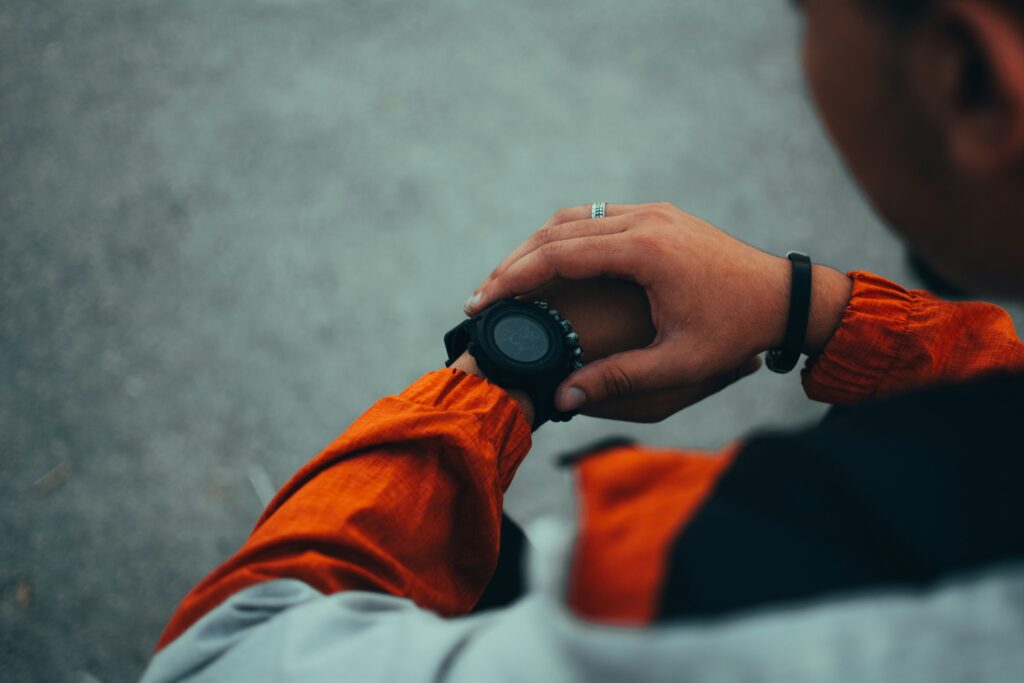
Mile 12 of a long climb. You feel strong. Legs are working, but not screaming. Breath is deep and even. You glance at your heart rate monitor.
The number is higher than you thought.
Zone 4 when you wanted Zone 3. Suddenly the climb feels harder. Your breath feels shallower. The legs you just called “strong” feel tight. You back off the pace.
But nothing changed except the number.
Your body was doing exactly what it was doing one second earlier. The hill is the same. Your fitness is the same. The only new information is a digit on a screen — and somehow that digit rewrote what your body was telling you.
That is the monitoring trap — a subtle form of heart rate monitor anxiety that’s quietly costing endurance athletes more than they realize.
What Interoception Actually Is
Interoception is a clunky word for a simple thing. It’s your ability to feel what’s happening inside your body. Your heartbeat without checking for it. How hard you’re breathing, without thinking about it. When you’re hungry, tired, anxious, or ready — from the inside out. Most elite athletes have strong interoception. They don’t just feel more. They trust what they feel— and it’s trainable.
Why Your Heart Rate Monitor Can Make Things Worse
Here’s where it gets interesting. When you check a wearable mid-effort, you’re not strengthening your body awareness. You’re replacing it. The number becomes the signal. The feeling gets quiet.
Decades of research on attentional focus back this up. In a classic line of studies, Gabriele Wulf and colleagues (2001; McNevin, Shea, & Wulf, 2003) showed that when athletes focus on their own body — an internal focus — their movements get less fluid, less automatic, and less efficient. When they focus outside the body, on the effect of the movement, performance improves.
A watch pulls your attention inward. But not to the felt sense of running. It pulls you to a number about your body. That is not interoception. That is self-surveillance. And your nervous system treats those two very differently.
Accurate interoception is built on trust. Self-surveillance is built on doubt.
Three Moves to Rebuild Your Interoception
1. Use the watch to calibrate, not to narrate.
A heart-rate monitor is useful while you’re learning your body. After enough miles, you start to feel what Zone 2 actually is. What Zone 4 feels like. What “about to blow up” feels like. Once you have that calibration, trust it. Glance at the watch to confirm what you already feel. Don’t glance at it to decide how you feel.
2. Run one session a week with no data.
No watch. No pace. No heart rate. Just you and the trail. This is the fastest way I know to strengthen interoception. If a full blind session feels like too much, start small. Cover the watch face for the first ten minutes of a run. Ask yourself how hard the effort feels. Then check. You’ll be surprised how often your body was right.
3. Ask the body-first question.
Before you look at the watch, ask: What is my breath doing? Where is the tension sitting? How smooth does my stride feel? Then look at the number. The order matters. If the number goes first, it hijacks your answer. If your body goes first, you train the internal signal to get louder over time.
The Real Work
Interoception is not about feeling more. It’s about trusting what you already feel.
The athletes I work with who hold up best under pressure — who recover faster from bad days, who don’t fall apart in the last hour of a hundred-miler — are not the ones with the best data. They are the ones who have learned to listen to a body that already knows what to do.
A wearable can help with that. It can also slowly replace it.
Your job is to notice which one is happening.
And that’s the deeper work, really. The monitoring trap isn’t just about watches. It’s about the habit of looking outside yourself for information your body is already giving you. The number on the screen. The reassurance from a coach. The comparison to last week’s splits. None of those are bad — until they become the only voice you trust.
Rebuilding that trust starts with how you relate to the signals your mind and body are already sending. If you want a place to begin, I put together a free 7-day guide called Rewire Your Thinking. One short practice a day. No wearable required — just you and what’s already there.
For more on the nervous system side of performance, start with Why You Dominate in Practice and Disappear in Competition, How to Break a Mental Block: A Nervous System Approach for Athletes, and Stop Trying to Conquer Your Feelings: Why the Best Athletes Perform With Emotion, Not Against It.
Dr. Trent Claypool, PsyD Licensed Sport Psychologist Summit Sport Psychology · Colorado Springs & Virtual Nationwide
References
Seabury, T., Benton, D., & Young, H. A. (2023). Interoceptive differences in elite sprint and long-distance runners: A multidimensional investigation. PLOS ONE, 18(1), e0278067. https://doi.org/10.1371/journal.pone.0278067
Wulf, G., McNevin, N., & Shea, C. H. (2001). The automaticity of complex motor skill learning as a function of attentional focus. The Quarterly Journal of Experimental Psychology A, 54(4), 1143–1154. https://doi.org/10.1080/713756012
McNevin, N. H., Shea, C. H., & Wulf, G. (2003). Increasing the distance of an external focus of attention enhances learning. Psychological Research, 67(1), 22–29. https://doi.org/10.1007/s00426-002-0093-6